

目录
| # | 曲目 | 时长 |
|---|---|---|
|
1 |
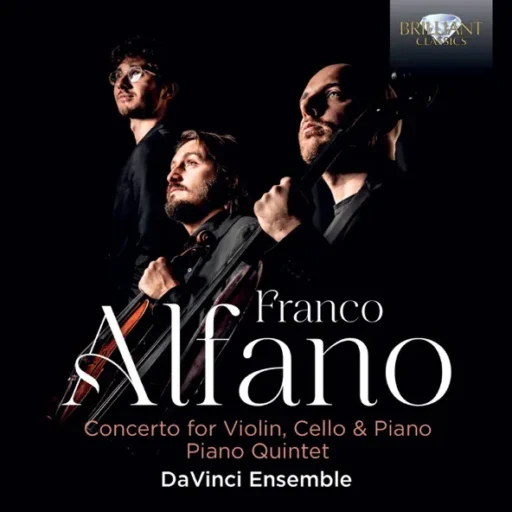
Concerto in A Major for Violin, Cello & Piano: I. Con Dolce Malinconia | 00:15:27 |
|
2 |
Concerto in A Major for Violin, Cello & Piano: II. Allegretto Fantastico | 00:08:22 |
|
3 |
Concerto in A Major for Violin, Cello & Piano: III. Presto, Con Grande Vigoria | 00:07:14 |
|
4 |
Piano Quintet in A-Flat Major: I. Largo | 00:14:30 |
|
5 |
Piano Quintet in A-Flat Major: II. Moderato Con Grazia | 00:07:34 |
|
6 |
Piano Quintet in A-Flat Major: III. Allegro | 00:07:56 |
专辑简介
Franco Alfano was born in Naples on 8 March 1875 and soon showed musical aptitude, studying piano with Alessandro Longo at the Conservatorio San Pietro a Majella in Naples and composition with Camillo De Nardis. In 1895 he moved to Leipzig to study with Salomon Jadassohn, where he was able to undertake deeper study of Bach and Wagner, as well as Busoni, Richard Strauss and other composers still little known in Italy. In the summer of 1899 he moved to Paris, encountering an even more stimulating environment where musical debate between such names as Massenet, Bizet, Charpentier and Debussy aroused his curiosity. His long career saw its greatest successes in the field of opera, his most successful being 1904’s Resurrection, based on Leo Tolstoy’s novel of the same name, L’ombra di Don Giovanni (1913 rev. 1941), La leggenda di Sakùntala (1921 rev. 1952, his masterpiece) and Cyrano de Bergerac (1936), along with eight other operas. In spite of this prolific operatic output, Alfano owes his fame today mainly to his completion of Puccini’s Turandot on the basis of notes left by the deceased composer. The decision to have Alfano complete the opera was taken by Arturo Toscanini and the publisher Ricordi because of affinities that Alfano’s Sakùntala had with the unfinished finale of Turandot. Alfano died in San Remo on 17 October 1954.
Begun in 1929 and quickly completed, the Concerto in A for Violin, Cello & Piano was performed on 31 May 1930 at the Accademia di Santa Cecilia with Luca Ballerini (violin) and Benedetto Mazzacurati (cello) along with Alfano himself on piano. It had a warm critical reception for its clarity, expressive intensity, powerful construction and ‘its effusive cantabile and substantial episodes’, all distinctive traits of the composer. Particularly appreciated was Alfano’s use of the ancient modes – a different one for each movement: Phrygian for the first (‘Con dolce malinconia’), Dorian for the second (‘Allegretto fantastico’) and Hypolydian for the last (‘Presto, con grande vigoria’). This concerto also displays absolutely masterful writing for the three instruments, which take up a truly animated discourse, each with a defined role and interesting individual timbral solutions and combinations.
Alfano’s final chamber music composition, the Piano Quintet in A flat for strings and piano dates from 1945. Written after a ten-year gap in Alfano’s chamber music output, the difference between the trio on this album and this piano quintet is evident. He uses less elaborate solutions in the later work, in fact, including doublings and emphatic unison tutti at resolutions and cadences. Ornamental material is more conspicuous here than before, lending the work a certain Art Nouveau flavor. Alfano displays a desire to return to a stylistic idea from the past, as of one consciously wanting to fall back on old certainties, idealizing and emphasizing them while distinctive Alfano traits remain evident, such as the genuineness of the lyrical impulse and the quality of the technical craftsmanship.

