

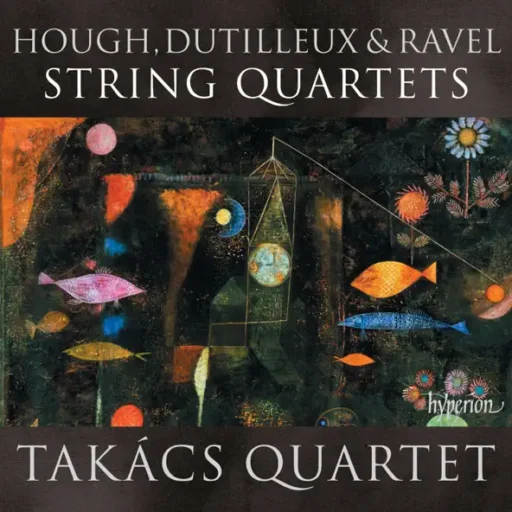
目录
| # | 曲目 | 时长 |
|---|---|---|
|
1 |
String Quartet No. 1 “Les Six rencontres”: I. Au boulevard | 00:03:05 |
| 2 | String Quartet No. 1 “Les Six rencontres”: II. Au parc | 00:03:25 |
| 3 | String Quartet No. 1 “Les Six rencontres”: III. À l’hôtel | 00:03:47 |
| 4 | String Quartet No. 1 “Les Six rencontres”: IV. Au théâtre | 00:04:39 |
| 5 | String Quartet No. 1 “Les Six rencontres”: V. À l’église | 00:02:55 |
| 6 | String Quartet No. 1 “Les Six rencontres”: VI. Au marché | 00:04:08 |
| 7 | Ainsi la nuit: I. Libre et souple – Nocturne | 00:03:26 |
| 8 | Ainsi la nuit: II. Parenthèse I – Miroir d’espace | 00:02:11 |
| 9 | Ainsi la nuit: III. Parenthèse II – Litanies | 00:02:53 |
| 10 | Ainsi la nuit: IV. Parenthèse III – Litanies II | 00:03:56 |
| 11 | Ainsi la nuit: V. Parenthèse IV – Constellations – Nocturne II | 00:03:12 |
| 12 | Ainsi la nuit: VI. Temps suspendu | 00:02:30 |
| 13 | String Quartet in F Major, M. 35: I. Allegro moderato, très doux | 00:07:57 |
| 14 | String Quartet in F Major, M. 35: II. Assez vif, très rythmé | 00:06:10 |
| 15 | String Quartet in F Major, M. 35: III. Très lent | 00:08:00 |
| 16 | String Quartet in F Major, M. 35: IV. Vif et agité | 00:05:26 |
专辑简介
In 1975, four students at the Franz Liszt Academy of Music in Budapest, Gábor Takács-Nagy (first violin), Károly Schranz (second violin), Gábor Ormai (viola), and András Fejér (cello) formed the Takács Quartet. Takács-Nagy, Ormai and Fejér had been playing trios together for several months when they met Schranz during a pickup soccer game after classes. With his immediate addition to the group, the trio became a quartet.
The quartet first received international attention in 1977, winning the First Prize and the Critics\’ Prize at the International String Quartet Competition in Évian-les-Bains, France. After that, the quartet won the Gold Medal at the 1979 Portsmouth and Bordeaux Competitions and First Prizes at the Budapest International String Quartet Competition in 1978 and the Bratislava Competition in 1981. The quartet made its first North American tour in 1982.
In 1983, the group decided it would be best for them and their families if they moved to the United States. A colleague offered them a position as quartet-in-residence at the University of Colorado at Boulder, and they accepted the job.
In 1993, Takács-Nagy left the group, and the British violinist Edward Dusinberre replaced him.[1] In 1994, Ormai learned that he had incurable cancer, and was replaced by another British musician, violist Roger Tapping. Following these changes, the quartet embarked on a successful series of recordings: a cycle of all six Béla Bartók quartets (dedicated to the memory of Ormai, who died in 1995) and a critically acclaimed complete Ludwig van Beethoven quartet cycle, as well as quartets by Bedřich Smetana and Alexander Borodin.

