

目录
| # | 曲目 | 时长 |
|---|---|---|
|
1 |
Indigo Park | 04:57 |
| 2 | Memory Palace (feat. Ezra Koenig) | 02:52 |
| 3 | Entropy Here (Rust in Peace) | 03:32 |
| 4 | Silhouette Shadows | 05:43 |
| 5 | Ecstatic (feat. Bonnie Raitt) | 02:51 |
| 6 | Alabama | 03:46 |
| 7 | North Dakota Slate Roof | 04:38 |
| 8 | Sliver of Time | 03:54 |
| 9 | Might As Well Be Me, Florinda (feat. Blake Mills) | 07:12 |
| 10 | Take A Light Strain | 03:53 |
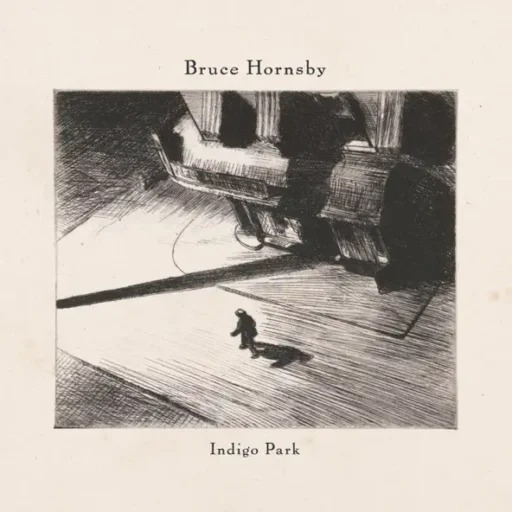
专辑简介
The refrain of “Ecstatic,” one of ten thoughtful songs on Bruce Hornsby’s new Indigo Park, describes the physiological sensations that often accompany a peak experience — the rush that’s common to surfing a massive untameable wave, or climbing a mountain, or composing a killer anthem.
Made my eyes jump round me,
Made my heart go beatin’ fast
Heard the roar come sounding,
Try to make the ecstatic last
The act of writing a song has been compared to bottling lightning; to compose is to chase the fleeting sense of the divine — and strive to somehow distill it into a precise constellation of rhythm and rhyme.
“Making the ecstatic last” is what every songwriter wakes up in the morning intending to do. It’s the job description, and also home court for Hornsby, whose discography includes a pile of enduring radio hits (“The Way It Is,” “Mandolin Rain,” “The End of the Innocence”) and critically acclaimed albums.
But on his new record, Hornsby isn’t aiming for breathless, shiny rhapsody every time. Another track finds him using the lexicon of physics to describe decline and decay: “Disorder near, entropy here,” he sings, in a gallows-haunted voice that sounds like it never encountered anything remotely like ecstasy. The hook: “I’m just trying to rust in peace.”
The ten songs of Indigo Park oscillate between those extremes. Light/dark. Memory/fantasy. Calm/rage. Doubt/certainty. One minute, Hornsby is using all the Beach Boys\’ earworm tools at his disposal to evoke the glorious, transcendent rush of air at the mountaintop. Then, a few songs later, he’s shuffling through a woozy bowery two-step, talking about sleeping on asphalt with an iron grate for a pillow. Telling anyone who’ll listen how the end of the world was not his fault.
These juxtapositions, so vivid in the rendering, are themselves a rarity now. Like many of his contemporaries, Hornsby is operating in a pop ecosystem that has grown narrower, more conformist, less adventurous. The edges and nuances that characterize so much of classic pop have been rounded off, disappeared, sanitized to satisfy the algorithm.
Hornsby’s response is to gleefully disregard those prevailing conditions. He goes full muso here, utilizing devices that, according to conventional wisdom anyway, the pop audience no longer has bandwidth for — absurdism, altered dominant chords, literary references, melodies with wide interval leaps, metaphor, changes of meter and texture, refrains that unfold over 16 measures rather than two.

