

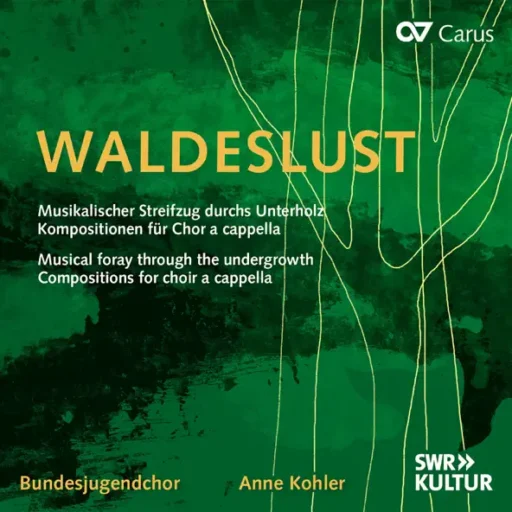
目录
| # | 曲目 | 时长 |
|---|---|---|
|
1 |
3 Sechsstimmige Chöre, Op. 39: No. 1, Schweigen | 00:04:10 |
| 2 | 3 Sechsstimmige Chöre, Op. 39: No. 2, Abendlied | 00:04:52 |
| 3 | 3 Sechsstimmige Chöre, Op. 39: No. 3, Frühlingsblick | 00:04:22 |
| 4 | waldeslust: No. 2, waldschwärze | 00:03:00 |
| 5 | 6 Lieder, Op. 59: No. 6, Jagdlied, MWV F 22 | 00:02:57 |
| 6 | waldeslust: No. 1, waldhochzeit | 00:03:05 |
| 7 | Romanzen und Balladen, Op. 75: No. 3, Der traurige Jäger | 00:02:22 |
| 8 | waldeslust: No. 3, waldblümelein | 00:02:31 |
| 9 | Woods (Arr. for 8-Part Mixed A Cappella Vocal Jazz Ensemble) | 00:05:16 |
| 10 | Ode an das Sägemehl für achtstimmigen gemischten Chor mit Knackfröschen | 00:07:24 |
| 11 | Magic Songs: No. 1, Chant to Bring Back the Wolf | 00:01:28 |
| 12 | Magic Songs: No. 2, Chant to Make Fences Fall Down | 00:01:13 |
| 13 | Magic Songs: No. 4, Chant for Clear Water | 00:01:55 |
| 14 | Magic Songs: No. 7, Chant to Make Bears Dance | 00:01:05 |
| 15 | Magic Songs: No. 8, Chant to Make the Stones Sing | 00:02:04 |
| 16 | Magic Songs: No. 9, Chant to Make the Magic Work | 00:01:30 |
| 17 | 3 Chansons, M. 69: No. 1, Nicolette | 00:01:55 |
| 18 | 3 Chansons, M. 69: No. 2, Trois beaux oiseaux du paradis | 00:02:52 |
| 19 | 3 Chansons, M. 69: No. 3, Ronde | 00:01:46 |
专辑简介
Paula Rein (alto), Tobias Ripplinger (bass (vocal)), Jakob Schuld (tenor), Annemarie Hoffmann (speaker), Felicitas Ammer (soprano), Evelyn Ruf (alto), Anna Schote (soprano), Isabel Grübl (alto), Jakob Reichmann (bass (vocal)), Bundesjugendchor, Anne Kohler-guitarist Nina Cates pieced together the lyrics in what she calls a “collection collage,” pulling from memories and journal entries she wrote during the period after the fire. Seemingly detached observations on weather and people-watching are flanked by an assortment of entities—sports radio, a smiley-face takeout bag, the trolley problem—that seem random until you realize the chaos is the point. “I don’t wanna get stuck like this,” repeats Cates, yearning for routine and calm.
Robber Robber don’t relive their apartment fire in literal terms on the album or dramatize the months spent living out of suitcases. Instead, they fill their songs with more oblique references to support systems, trash and grime, the insatiable need for stability—processing how class and community inform the experience of displacement. Gratitude for having a place to close your eyes doesn’t erase the loneliness of nomadic living. It’s especially true in Vermont, where wealth disparities separate generational blue-collar families from the snow bunnies and post-pandemic homeowners chasing the state’s idyllic stereotype in the face of a homelessness crisis. Rearrange her lyrics and Cates’ intentionally fractured scenes clearly flit between the trepidation, despair, and resigned acceptance familiar to certain locals.

