

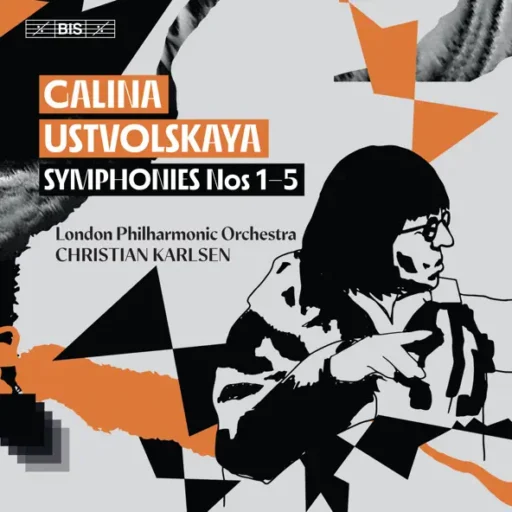
目录
| # | 曲目 | 时长 |
|---|---|---|
1 | Symphony No. 1 I. [Quarter Note = 60] | 00:03:36 |
| 2 | Symphony No. 1 IIa. Ciccio | 00:02:54 |
| 3 | Symphony No. 1 IIb. Carousel | 00:01:57 |
| 4 | Symphony No. 1 IIc. Saturday evening | 00:01:46 |
| 5 | Symphony No. 1 IId. The boy from Modena | 00:02:10 |
| 6 | Symphony No. 1 IIe. Buy jumble | 00:01:43 |
| 7 | Symphony No. 1 IIf. Waiting room | 00:03:15 |
| 8 | Symphony No. 1 IIg. When factory chimneys die | 00:01:38 |
| 9 | Symphony No. 1 IIh. Sun | 00:03:16 |
| 10 | Symphony No. 1 III. [Quarter Note = 108] | 00:07:15 |
| 11 | Symphony No. 2 “True and Eternal Bliss!” | 00:21:51 |
| 12 | Symphony No. 3 “Jesus Messiah, Save us!” | 00:15:12 |
| 13 | Symphony No. 4 “Prayer” | 00:07:02 |
| 14 | Symphony No. 5 “Amen” | 00:13:24 |
专辑简介
Galina Ustvolskaya was a profoundly original composer, unrivalled in the extremism of her style, who was largely ignored during her lifetime. Fiercely independent, Ustvolskaya created highly expressive, even violent music that sounds like the work of no other composer and reveals no distinct influences, while often being imbued with religiosity or spirituality. Her music has been described as having the ‘narrowness of a laser beam capable of piercing metal’.
Only after her death was Ustvolskaya’s original and uncompromising talent finally recognised. Christian Karlsen and the London Philharmonic Orchestra present here Ustvolskaya’s five symphonies. While the first appears superficially traditional (it is the only one for full symphony orchestra), it features two boys singing – through microphones, in a chanting manner – texts that speak of poverty, racism and injustice. Symphonies Nos 2 to 5 break decisively with the traditional mould; each consists of a single, rather short movement, in the manner of theatrical rituals. Written for instrumental combinations as varied as they are unusual, these symphonies became increasingly intransigent as their instrumentation contracted further and further, down to just a handful of instruments in the Fourth and Fifth Symphonies. A solo voice appears sporadically, not necessarily for singing, but rather to verbalise a prayer – a prayer asking for forgiveness but not for a better life.

