

目录
| # | 曲目 | 时长 |
|---|---|---|
|
1 |
Medea: Look at Me | 00:09:15 |
| 2 | Medea: To Let Yourselves Be Healed | 00:14:19 |
| 3 | Medea: If I Could Exhume My Murdered Children | 00:11:09 |
| 4 | Medea: Whose Arms, Cradling Pounding Hearts | 00:12:43 |
专辑简介
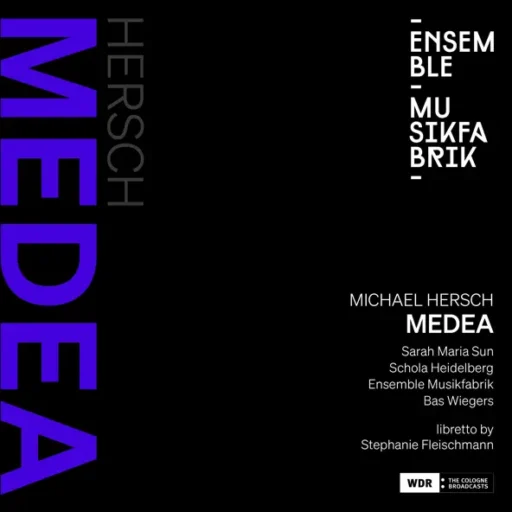
“As she lay wrestling and with all her reason unable to master her madness, she said, ‘Medea, you struggle in vain.’” The ancient poet Ovid gives the magical female figure of Greek mythology a great deal of attention in his “Metamorphoses,” and in these words, near the beginning (lines 10 and 11) of his reflections on Medea, her fate already metaphorically looms: the inescapability of murderous entanglements in the tension between divine providence and her own will, driven first by love, then by hatred and despair. Her husband Jason left her for another woman, years after she helped him achieve power and fame through magic, and in revenge for her spurned love, Medea killed their children. Against the backdrop of this dramatic story and the archaic force of its actions, it is not surprising that the saga of Medea has consistently endured as an important subject in cultural and musical history – up to the present day in the work of American composer Michael Hersch, who delivers the latest sound adaptation with his large-scale “MEDEA” for the soprano Sarah Maria Sun, the Schola Heidelberg, and the Ensemble Musikfabrik.
Hersch is not beholden to the prominent templates, as the harsh cluster-like chords sounding triple forte from the two pianos in the work’s second measure immediately demonstrate. They unmistakably signal that in this “MEDEA,” a monodrama in one act with a libretto by Stephanie Fleischmann, the depths of psychological and emotional extremes will be powerfully negotiated. With increasing emphasis, Medea ponders her own deeds in a harrowing monologue—flanked by a chorus that grows from a commentator and reflector to her alter ego and increasingly identifies itself with her. Almost like a defendant giving a closing argument, as a figure just as self-confident as she is traumatized, she turns to her supposed judge, the audience, but also to imaginary higher authorities and, last but not least, to herself: “Look at me / I am different, strange / You do not know me / The hole in the sky / that always follows me / wherever I fly. / The swaying ground beneath me / covered in the dust / skin and bones / of many generations.”
In these opening lines, Medea stylizes herself as a mysterious “stranger” and plays with the dichotomy between fear and fascination that is still relevant for the perception of the “foreigner” and the unknown. This aspect already comes into play in Luigi Cherubinis’s Opera “Médée” (1797/1802), in which she as a terrifying sorceress celebrates her horrific revenge on Jason. In 1953, the opera gained greater popularity through Maria Callas’s interpretation of the title role. Maria Callas also endowed the figure of Medea with maximum intensity in Pier Paolo Pasolinis’s similarly titled 1969 film, which explicitly highlights the motif of foreignness and her position as social outsider.

